

Referrals got you your first 10 clients. They won’t get you your next 50. Here’s what it actually takes to grow a private practice past that point.
Key takeaways:
- Referrals and Psychology Today can start a practice, but it caps out fast once your caseload outgrows word of mouth.
- A website built to convert outperforms a directory listing because it works around the clock and answers a potential client’s questions before they ever pick up the phone.
- Two real practice rebuilds generated inquiries directly through the website: one produced 4 new inquiries in 2 weeks with zero ad spend, the other generated 16 inquiries through the contact form and Google Business Profile before any SEO work began.
- More than 40 million people ask ChatGPT health questions every day, and a practice that isn’t set up for AI search is invisible to a growing share of the people looking for care.
- Growth compounds when directories, referrals, and social media all point back to one strong website instead of competing with it for attention.
How Do You Actually Grow a Private Practice in 2026?
Growth comes from one system, not 20 tactics. A website built to convert sits at the center of it.
Everything else, your Google Business Profile, your Psychology Today listing, your referral network, your social media, works better when it feeds that one asset instead of operating on its own.
That’s a different model than the one most therapists start with. Early on, a practice usually runs on referrals and a directory listing. That works fine at 10 or 15 clients. It starts breaking down once you need thirty.
The problem isn’t that referrals stop coming. It’s that you don’t control when they come, how many arrive in a given month, or whether they match the specialty you actually want to build a caseload around.
Push a practice past that ceiling, and the channels change. You start needing a way for the right clients to find you on their own, on their schedule, without you asking anyone to remember your name. That’s what a website does when it’s built correctly. The rest of this guide covers exactly how.
nnnIf you’re licensed in more than one state, growth looks different again. Here’s what actually builds visibility in a state where you don’t have an office.
Why Isn’t Psychology Today and Word of Mouth Enough Anymore?

Psychology Today still costs $29.95 a month, the same price it’s charged for years. What that $30 buys has changed.
Therapist community reports on Reddit and in private Facebook groups increasingly describe inquiry volume dropping hard since 2020, from 8 to 15 contacts a month down to 1 to 3 by 2025 and 2026. Psychology Today says its pricing and algorithm haven’t changed. What’s changed is the number of therapists competing for the same search results.
A directory listing puts you on a page with dozens, sometimes hundreds, of other providers in your city. You’re not marketing to a client at that point. You’re competing for their attention against everyone else on the same page, using the same format, saying roughly the same things.
Word of mouth has a similar ceiling. It works, but it’s inconsistent by design. A slow month isn’t a sign something’s wrong. It’s just what happens when your entire growth strategy depends on other people remembering to mention you.
Play that out over a real caseload and the cost gets specific. A therapist relying on referrals alone often can’t predict whether next month brings 2 new clients or 0, which makes it hard to plan anything, from hiring an associate to simply knowing whether to keep a waitlist open.
A cancellation becomes a real financial gap instead of a minor inconvenience, because there’s no steady inbound flow to fill the slot quickly. Some therapists respond by adding a second or third directory listing on top of Psychology Today, paying multiple monthly fees while still having no real control over how many inquiries any of them produce in a given month.
Neither of these is a channel you own. You can’t improve your Psychology Today ranking through better work. You can’t control how many people talk about you this month versus last month. The asset that fixes this is one you actually control: a website built to do the job a directory listing and a referral network can’t do.
What Makes a Therapist Website an Actual Growth Engine?
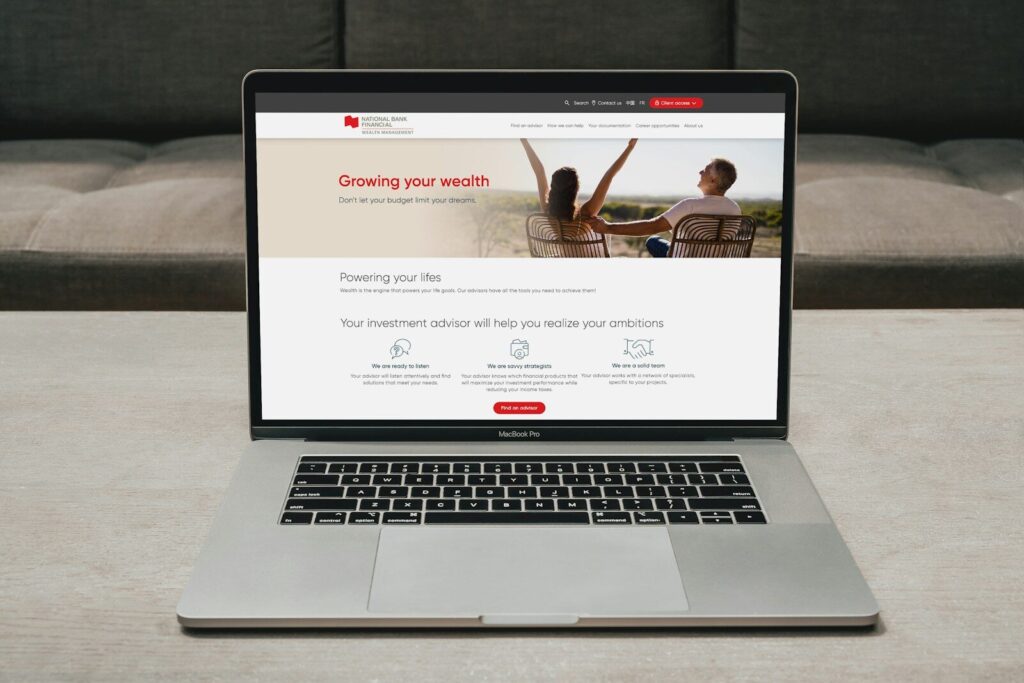
A website works as a growth engine when it answers a potential client’s real questions before they ever call, and gives them a clear, easy way to book once they’re convinced. That’s not the same as simply existing online. That’s the bar our website design for therapists work is built to clear.
Two real rebuilds show what this looks like in practice. The therapist website design guide walks through the fundamentals these builds share.
The first was a group practice in Pennsylvania worked with Clarity Desing Co, five counselors, 22 years in business, with zero organic inquiries before the rebuild. The practice had relied entirely on Psychology Today, an old outdated website on the Weebly platform, and word of mouth.
The new site went to 21 pages, including individual bio pages for each counselor and one specialty modality positioned around a keyword with almost no competition. 4 inquiries came in through the site in the first two weeks. No paid ads, no SEO touch at that point. See how branding factored into that same rebuild.
The second was a solo LMFT with a dual-state license and no SEO presence at all. The old site had an outdated rate listed and a phone-first contact method that didn’t match how the therapist actually wanted to work.
The rebuild with us went to 11 pages, added a full brand identity, and used copy pulled directly from the therapist’s own intake language rather than generic service descriptions. 16 inquiries came through the website contact form and Google Business Profile before any SEO work had even started. The conversion fix alone did that.
Neither of these results came from a bigger ad budget or a louder social media presence. They came from a website our strategist built that did its actual job: answer questions, build trust, and make booking easy.
Notice what both rebuilds have in common. Neither one is a generic template with a therapist’s name swapped in.
The group practice site gave every counselor a real bio page instead of burying five people on one “our team” page, because a prospective client searching for a specific specialty wants to find the person who handles that specialty, not scroll through everyone.
The solo LMFT site used the therapist’s actual intake language instead of stock service descriptions, because the words a client sees on a website are often the first real signal of whether this therapist understands what they’re going through. Small differences like these are what separate a site that sits online doing nothing from one that actually brings in clients.
How Is AI Search Changing the Way Clients Find a Therapist?
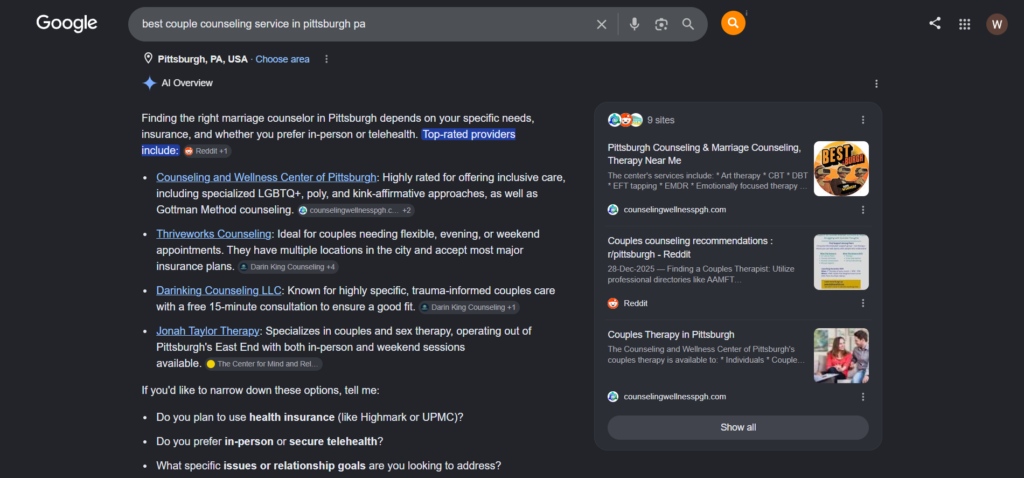
AI tools are becoming a real referral source, and a practice that isn’t built for them is starting from behind. We break down exactly what that shift means in AI search for therapists.
OpenAI reported in January 2026 that more than 40 million people ask ChatGPT health-related questions every single day. Roughly 3 in 5 U.S. adults said they’d used an AI tool for a health question in the past 3 months.
Some of those questions look exactly like what used to happen on Google: “Find a trauma therapist who takes insurance near me” or “What’s the difference between EMDR and talk therapy?” The person asking isn’t going to click through 10 search results anymore. They’re going to read whatever answer the AI tool gives them, built from whatever sources it trusts enough to pull from.
That changes what a website needs to do.
❌ A page that lists services in vague, generic terms gives an AI tool nothing specific to cite.
✔ A page that answers a real question clearly, in a format that can be lifted out of context and still make sense, gives it something worth citing.
This is the same principle behind how Google builds featured snippets, and it’s why SEO, AEO, and GEO have become one connected skill instead of 3 separate ones. Our full breakdown of that framework lives in the therapist website SEO guide, which goes deeper into the technical side of building for both traditional search and AI search at once.
How Long Does It Actually Take to See Growth from Your Website?
Two different clocks are running here, and it helps to know which one you’re watching.
Conversion improvements move fast. Clearer service pages, a working contact form, and copy that actually sounds like you instead of a generic template. All 3 can produce inquiries within months. The solo LMFT rebuild above generated 16 inquiries before any SEO work had even started, purely because the site finally did its job.
Organic search rankings move slower. Real visibility from Google typically takes 3 to 6 months to build, sometimes longer for competitive terms in a crowded city. AI search citation tends to follow a similar timeline, since it depends on the same signals of trust and clarity that traditional SEO does.
Anyone who tells you a website will rank in 2 weeks is selling something, not describing how search actually works. If organic visibility is the piece you’re missing, SEO for therapists is where that work happens.
Expect quick wins on conversion. Expect search visibility to compound over months, not days. Both matter, and they move at different speeds.
Where Do Directories, Referrals, and Social Media Fit In?
They still matter. They just work better when they all point back to one strong website instead of standing on their own. If your Google Business Profile still needs work, this Google Business Profile checklist is a good place to start.
Each channel plays a different role:
- Psychology Today: highest-intent traffic, someone actively looking for a therapist right now, but it competes against every other listing on the same page.
- Referrals: the highest close rate of any channel, because someone already vouched for you, but the least predictable.
- Social media: builds familiarity over time, but rarely converts a stranger into a booked client on its own.
Your website is what ties these together. A directory profile that links to a real, well-built site gives a prospective client somewhere to go deeper before they decide. A referral who checks you out online before calling finds a site that confirms what they were already told.
Social media posts that link back to specific pages, not just your homepage, turn a passing scroll into an actual visit. None of these channels replaces the others. They all get stronger once your website gives them something worth linking to. Our marketing for therapists guide covers how to make that work without burning hours a week.
Client acquisition cost makes the priority clearer:
- A directory listing has a fixed, ongoing cost whether it produces 1 inquiry or 10 that month.
- A referral costs nothing upfront but takes years of relationship-building to generate reliably.
- A website has a real upfront cost, then keeps producing inquiries for years without an ongoing per-lead price tag once it’s built and ranking.
Over time, that math tends to favor the channel you actually own.
Where Should You Start?
Start with whichever piece is actually broken. That’s the fastest way to grow a private practice without wasting money guessing.
If your website hasn’t produced an inquiry in months, that’s a conversion problem, not a traffic problem, and it’s a faster fix than most people expect. Start with your homepage and your top service page. Clearer language and one obvious next step can move the needle inside a few weeks.
If your site gets visits but doesn’t show up for anything worth ranking for, that’s a visibility problem, and it takes longer to fix. The therapist website SEO guide covers the technical side of that.
If you’re not sure which one it is, that’s worth a second set of eyes before you spend money guessing which piece to fix first.
A referral disappears the moment somebody stops mentioning your name. A website keeps working long after that conversation ends. That’s what it actually takes to grow a private practice, not just market one.
If your site hasn’t brought in a new inquiry in the last month, book a free website growth review and we’ll show you exactly what’s holding it back.
FAQ
u003cstrongu003eHow do therapists get new clients besides referrals?u003c/strongu003e
The most reliable channels beyond referrals are a website built to convert visitors into booked calls, a complete Google Business Profile, and AI search tools like ChatGPT and Perplexity, which now answer u0022find a therapist near meu0022 style questions directly. Directories like Psychology Today still bring in clients, but they work best as one channel among several, not your only source of new clients.
u003cstrongu003eIs it worth having a website if I’m already listed on Psychology Today?u003c/strongu003e
Yes. Psychology Today’s SEO benefits its own domain, not your individual profile, and self-reported inquiry volume has dropped sharply for many therapists since 2020 as more providers list on the same pages. A website you own keeps working specifically for your practice, gives you a path to AI search visibility, and doesn’t disappear if you ever cancel a subscription.
u003cstrongu003eHow long does it take for a private practice website to bring in new clients?u003c/strongu003e
Conversion improvements, like clearer service pages and a working contact form, produce inquiries within weeks. Organic search rankings take three to six months to build meaningful visibility, and AI search citation follows a similar timeline.
u003cstrongu003eDo I need SEO if I already get consistent referrals?u003c/strongu003e
Referrals are unpredictable by nature, even when they’re consistent on average. SEO builds a second, independent source of new clients that doesn’t depend on someone else remembering to mention your name. Practices with both have steadier caseloads than practices relying on referrals alone.
u003cstrongu003eWhat’s the difference between marketing a private practice and growing one?u003c/strongu003e
Marketing is the individual actions: posting on social media, running an ad, updating a directory listing. Growth is the system those actions feed into. A practice can market nonstop and still not grow, because none of it converts unless it points back to a website built to turn that interest into booked sessions.