

This therapist website SEO guide skips the padding. Search “SEO for therapists” and you’ll get tens of guides telling you to fix your title tags, claim your Google Business Profile, and write blog posts. Most of them are right. None of them tell you where to actually start, or what to skip because it won’t move the needle for a practice your size.
This is that therapist website SEO guide. Not a checklist to complete once. A map you can come back to.
The cost of getting this wrong isn’t abstract, and it’s exactly what this therapist website SEO guide is built to prevent. It’s the practice that’s been open for two years and still runs entirely on referrals, because the website itself has never brought in a single inquiry.
It’s the solo therapist paying for a beautiful site that nobody who searches “anxiety therapist” near her actually finds.
A website that doesn’t rank isn’t just a missed opportunity. It’s an ongoing dependence on word of mouth in a field where a lot of new clients start their search alone, at night, on a phone, typing something into Google before they’ve told anyone they’re looking.
Key Takeaways From This Therapist Website SEO Guide:
- SEO for a therapist website covers four things that work together: site structure, local search signals, page speed, and the content that answers what a potential client is actually asking.
- Clients now find therapists through AI tools like ChatGPT and Gemini, not just Google, and most therapist websites aren’t built for that yet.
- Keyword stuffing and publishing volume for their own sake don’t move rankings the way they used to. Consistency and real depth do.
- A basic SEO engagement for a therapy practice typically runs $197 to $799 a month, and the right choice depends on how much of the work you can realistically do yourself.
- A group practice with 0 organic inquiries went to 4 new inquiries in 2 weeks after a structural rebuild with Clarity Design C, no paid ads involved.
What SEO Actually Means for a Therapist’s Website
SEO is the work of helping Google and, increasingly, AI tools understand what your practice does, who it helps, and why they should trust you enough to show your site to someone searching for care.
For a therapist, that breaks into four working parts.
Site structure determines whether Google can tell what each page is actually about.
Local signals determine whether you show up for someone searching near a specific city or neighborhood.
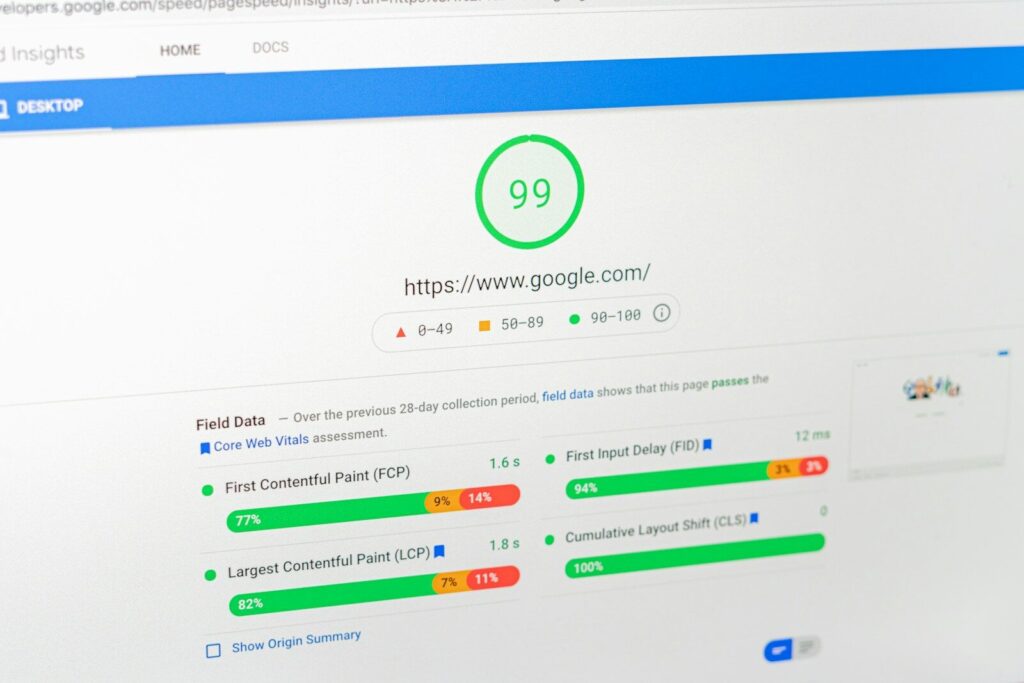
Page speed and technical basics determine whether Google can crawl your site at all without friction.
And content, the blog posts and service pages themselves, determines whether you’re answering the actual questions a potential client is typing into a search bar.
None of these four work in isolation. A fast, well-structured site with no content still has nothing to rank for. A site full of blog posts but with a confusing structure buries its own best pages. They move together or not at all.
Picture a solo therapist who treats anxiety and works with couples.
If her site has one page listing both services, Google has to guess which one to show for either search, and it usually shows neither prominently. If she splits those into two dedicated pages but her Google Business Profile still lists her under the wrong category, local search results skip her anyway.
Fix both, and now a slow-loading site still costs her the visitors who leave before the page even finishes loading. Each piece removes a different bottleneck. Skipping one leaves the others working at a fraction of their potential.
This therapist website SEO guide isn’t written for a therapist doing SEO as a side project between sessions. It’s written for a practice owner trying to decide what to prioritize, what to hand off, and what it’s actually going to cost either way.
The SEO Ranking Factors for your Practice That Actually Move the Needle
This therapist website SEO guide starts with three things that matter more than everything else combined for a therapy practice’s search visibility.
Specialty pages beat a single generic services page. A practice that treats anxiety, couples work, and trauma needs three distinct pages, each written around how a real client searches for that specific concern, not one page that lists all three in a paragraph. Google can’t rank a page for “couples therapist” if the page is actually about five different services.
Your Google Business Profile carries more weight locally than almost anything on your actual website. Category selection, consistent hours, real photos, and a habit of responding to reviews all feed directly into whether you show up in the map results most people click before anything else.
Site speed and mobile usability are table stakes, not differentiators. A slow site doesn’t get penalized so much as it gets skipped, since most potential clients are searching on a phone and won’t wait. This is one of the few places where a fix is purely technical and doesn’t require ongoing content work.
Everything past these three matters, but matters less. A backlink from a legitimate local organization, a hospital referral network, or a professional association signals real-world credibility to Google, and it’s worth pursuing over time.
Directory listings on Psychology Today or GoodTherapy help, provided the information matches your website exactly, since a mismatched phone number or address across platforms actively hurts local trust signals rather than just doing nothing.
A well-optimized about page helps a visitor decide to reach out once they’ve already found you. None of these make up for a site with no specialty pages, a neglected business profile, or a three-second load time. They’re the second wave of work, not the first.
How AI Search Changes What Ranking Means Now for your therapy practice website.
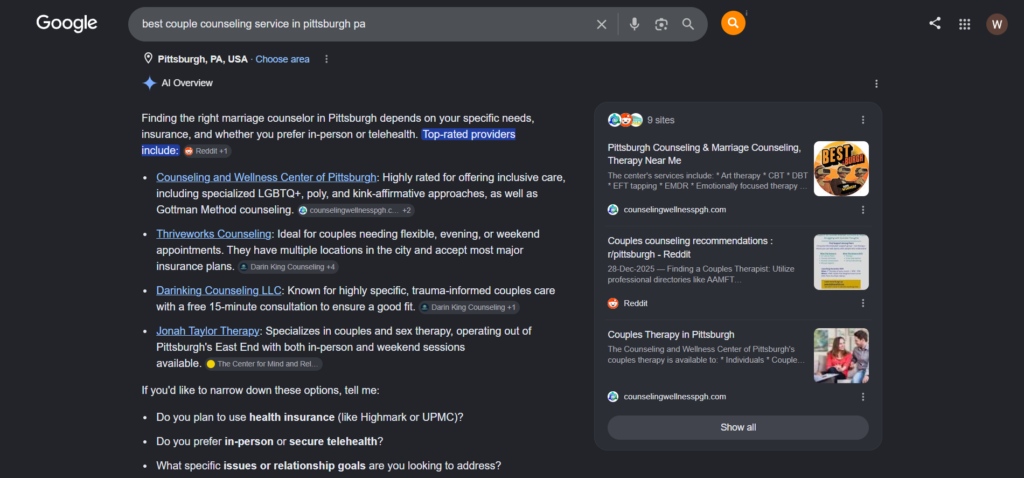
A potential client today might not search Google at all. They might ask ChatGPT “how do I find a trauma therapist who takes insurance in Denver,” or ask Gemini to compare a few practices near them. Neither of those tools works the way Google’s search results page works, and neither one is optional to think about anymore.
This is where AEO and GEO come in. Answer Engine Optimization is about getting pulled into a featured snippet or a direct answer box, the kind of result that shows up without anyone clicking through. Generative Engine Optimization is about being the source an AI tool actually cites when it summarizes an answer for someone.
Both depend on the same underlying habit: writing content that answers a specific question completely, in a self-contained chunk, without requiring the reader to piece it together from the rest of the page.
A subheading phrased as a real question, answered directly and fully in the next few sentences, does double duty. It’s the exact structure Google pulls into a featured snippet, and it’s the exact structure an AI tool can lift and cite without misrepresenting what you actually said.
Here’s what that looks like in practice. A weak version of an answer might say sliding scale pricing “depends on a few factors and varies by practice. ” An AI tool has nothing to cite there, since it doesn’t actually answer anything.
A strong version states the specific range, the documentation required, and how long the rate holds, all in the same short paragraph. That second version is the one that shows up when someone asks an AI tool directly instead of searching Google at all.
None of the major generalist guides on this topic mention AI search at all. That’s not because it doesn’t matter. It’s because most of them were written for how search worked a few years ago, not for where clients are actually looking now.
What Doesn’t Matter as Much as Therapists Think for Website SEO.
Keyword stuffing died as a strategy years ago, but the instinct behind it hasn’t. Repeating “anxiety therapist Denver” five times on a page doesn’t help you rank for it and reads as unnatural to both a visitor and to Google’s own systems. One clear use per page, with natural variation elsewhere, does the same job without the cost.
Publishing volume for its own sake doesn’t move rankings the way people assume. Three well-researched, genuinely useful posts a month will outperform ten thin ones, and Google’s own guidance backs this directly: consistency and quality matter more than raw frequency. A practice that publishes once a week forever beats one that publishes daily for a month and quits.
Chasing every possible keyword spreads a small site too thin to rank for any of them. A solo practitioner doesn’t need fifteen specialty pages. They need the two or three that reflect what they actually do best, built out properly, rather than a dozen built halfway.
A fourth myth worth naming directly: more pages on your practice website don’t automatically mean more authority. A 20-page site with ten thin, generic pages ranks worse on the whole than a 12-page site where every page has real depth. Google evaluates a site’s overall quality, not just its size, and a handful of weak pages can drag down pages on the same site that would otherwise rank well on their own.
Therapy Website SEO Cost and DIY vs. Hiring It Out
This is the actual decision most practice owners are stuck on, and it’s the one this therapist website SEO guide won’t skip.
Doing SEO yourself costs time, not money, and the time cost is real. A realistic weekly load looks like this: 2 to 3 hours writing or updating content, thirty minutes keeping the Google Business Profile current and responding to reviews, and periodic technical checks on page speed and broken links that take longer the first time and less after that.
None of it is a one-time project. It’s ongoing, the same way client documentation is ongoing. For a solo practitioner already at capacity with client hours, that time has to come from somewhere, and it’s usually either evenings or client capacity itself.
Hiring it out has a real, fixed cost. At Clarity Design Co, a monthly SEO engagement for a therapy practice typically runs in two tiers: a lower tier around $197 a month covering on-page fixes and a handful of target keywords and a higher tier around $799 a month adding business profile management, directory audits, and more frequent content.
There’s usually no setup fee, and a six-month minimum is standard since SEO takes time to compound. After that, most agencies let you continue month to month.
What that spend actually buys shows up in real outcomes, not promises. One group practice in Pennsylvania, with 5 counselors and over 2 decades in business, had zero organic inquiries before a structural rebuild with Clarity Design Co.
They relied entirely on Psychology Today and word of mouth. After rebuilding into individual specialty and counselor bio pages, they had 4 inquiries in the first 2 weeks, with no paid advertising involved, and the migration protected every existing page from broken links in the process.

A solo LMFT with a dual-state license saw 16 inquiries through her contact form before any dedicated SEO work even started, just from a site restructured around how her actual clients search and one low-competition keyword nobody else in her state was targeting.
Neither result came from doing more.
Both came from fixing the structural basics first.
More From This Therapist Website SEO Guide
This therapist website SEO guide is the starting map. Each of the pieces above has its own full breakdown already written.
If your site’s structure is the problem, Why Is My Therapy Website Not Ranking? walks through exactly what a specialty-page architecture should look like and why most sites default to something weaker.
If you’re deciding what to build your site on in the first place, Best Website Builder for Therapists: Squarespace, Wix, or WordPress? breaks down what each platform actually supports.
If you’re weighing a template against something custom, Template Website vs. Custom Website for Practitioners covers what genuinely affects your rankings and what’s just marketing from the builders themselves.
Not sure which of these applies to your site right now? Get a free therapy website audit and find out exactly where you stand.
How much does SEO cost for a therapist website?
A typical monthly SEO engagement for a therapy practice runs $197 to $799 a month, depending on how much is included, on-page fixes and a handful of keywords at the lower tier, and full business profile management and more frequent content at the higher tier. Most agencies require a six-month minimum since SEO takes time to compound.
Should you hire an SEO agency or handle it yourself?
It depends on your available time more than your budget. SEO takes 8 to 10 hours a week done well, ongoing rather than as a one-time project. If you’re already at capacity with client hours, hiring it out usually pays for itself faster than the time you’d spend learning and doing it piecemeal.
How long does SEO take to show results for a therapy practice?
Structural fixes, like adding real specialty pages and fixing keywords and duplicate content, can produce inquiries within a month. Broader ranking improvements typically take 3 to 6 months to compound, since Google needs time to recrawl and re-evaluate a site after meaningful changes.
Does SEO still matter if people are asking ChatGPT instead of Google?
Yes, and it matters more, not less. AI tools cite sources that are clearly structured and specific, which means the same fundamentals that help you rank on Google, clean site structure and content that answers real questions directly, are also what get you cited by AI search tools.
Why isn’t your therapist website showing up on Google even though it looks good?
A visually polished site can still lack the structural basics Google looks for: distinct specialty pages, a complete and active Google Business Profile, and content that answers specific client questions. Design and SEO are separate jobs, and a site can succeed at one while missing the other entirely.